A Singapore Government Agency Website

Looking After Parents Together with Siblings
Work out how to share caregiving responsibilities.


Looking After Parents Together with Siblings
30 Oct 2026 ⋅ 5-min read
As parents grow older and need more help, siblings may need to work together in new ways. This can bring up many feelings, including sadness, uncertainty, or past family memories.
Every sibling may see things differently. Shared family history can shape how each person understands a parent’s needs, makes decisions, and relates to the parent. Different views can make care discussions harder, especially when emotions are involved.
There is no single right way to share the care. What matters is talking openly and having a plan that helps siblings support one another while caring for their parents with respect.
The tips below may help you and your siblings talk through care needs and work out how to share responsibilities more clearly.
Consider these:
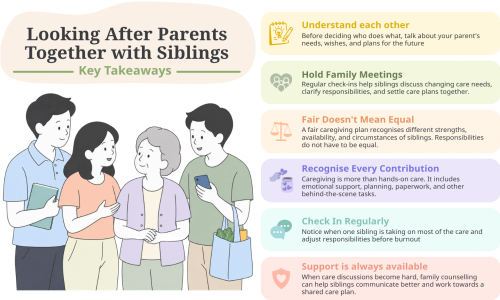
- Start by understanding each other
- Hold a family meeting
- Fair does not always mean equal
- Recognise all contributions
- Notice when one sibling is doing most of the caregiving
- When a sibling cannot or does not contribute
- How family counselling may help
Start by understanding each other

Siblings may not always agree on what a parent needs. One may feel that more support is needed now, while another may feel the parent can still manage on their own. Some may focus on safety, while others may focus on the parent’s wishes and quality of life.
- What support does your parent need now?
- What does your parent want?
- What may change in the coming months?
- Which decisions need to be made together?
Where possible, include your parent in these conversations. This helps them stay involved in decisions that affect their life.
Disagreements are common. When that happens, try to listen to the concern behind each person’s view before making decisions.
For example, someone might say:
- “I am concerned that we are making decisions without asking Dad.”
- “I am worried that Mum may no longer be safe at home alone.”
- “I want to help, but I cannot manage the daily tasks.”
Hold a family meeting

A planned family meeting gives everyone time to prepare. Choose a time when you and your siblings are less rushed and can focus. Try to keep the conversation on what is happening now, rather than bringing up past disagreements.
It helps to write down what everyone agrees on.
- What tasks are already being done?
- What has not yet been sorted out?
- What can each sibling be responsible for/take charge of?
- How often should the family review the plan?
Tension can build when people assume others know what needs to be done. It is usually more helpful to ask for what you need, rather than dropping hints or making general complaints.
Fair does not always mean equal

Siblings may not be able to help in the same way, and that is okay. A fair plan allows each person to contribute in a way they can. One sibling may have more time. Another may live farther away but can help with money matters or paperwork. Someone else may offer emotional support or help during emergencies.
- How far each sibling lives from the parent;
- Work and family commitments;
- Health and financial circumstances;
- Each sibling’s practical strengths;
- The relationship each sibling has with the parent; and
- The time and effort different tasks require.
Fair does not mean every contribution must look the same. It means the plan is clear, realistic, and respectful of everyone involved.
Recognise all contributions

Caregiving involves more than the tasks others can see. Before deciding on who does what, it helps to look at each sibling’s strengths, their availability, and limits.
Tasks may include taking a parent to appointments, preparing meals, or arranging transport. Other tasks happen in the background, such as tracking appointments, noticing changes in a parent’s condition, and updating family members.
Emotional support also takes time and energy. A sibling who speaks with the parent every day may be helping in ways others do not see. Listing all tasks can help you and your siblings recognise the work involved and appreciate one another’s efforts.
A sibling who lives farther away can still take an active role. They may help with managing finances, paperwork or service providers. Matching tasks to each person’s strengths and availability helps everyone contribute in a practical way.
Notice when one sibling is doing most of the caregiving

Sometimes, one sibling ends up taking on most of the care. This can happen gradually, especially if they live closest to the parent, have a more flexible schedule, or feel a strong sense of family duty.
Over time, this person may become the main caregiver without a clear conversation about it. They may start to feel tired or unsupported, while others may not realise how much they are doing.
- Is the current arrangement still manageable?
- Which tasks can others take on?
When a sibling cannot or does not contribute

Not every sibling can help in the same way. Some may be managing their own health, work, financial, or family needs. Others may have a difficult relationship with the parent or may not feel able to take on certain care tasks.
Before assuming that your siblings do not care, try asking what they can offer. For example: “I understand regular visits may not be possible for you. Is there another task you could take on?” Specific options are often easier to respond to than a general request to “help more”.
In some situations, a sibling may still choose not to contribute.
- What other support is available, this may include relatives' help and professional caregiving support;
- Which decisions can move forward without everyone’s agreement.
It is often more useful to build a care plan around the support that is available, rather than wait for support that may not come.
How family counselling may help

Sometimes, siblings keep having the same disagreements even when they want to move forward. Care discussions can also bring up old family matters.
Family counselling can provide a calm space to talk through care concerns and family matters.
It can help siblings communicate more clearly, agree on responsibilities, and understand one another’s views. Siblings may not resolve every past disagreement, but they can still work towards a plan that supports their parent, recognises each person’s contribution, and make sure that no one carries the care alone.
Images in this article are created with AI.