A Singapore Government Agency Website

Getting Along with Other Family Members
Maintain family harmony and personal well-being

Getting Along with Other Family Members
30 Oct 2026 ⋅ 3-min read
Healthy boundaries with the extended family support your well-being and help couples build stronger connections. They help you decide what you are comfortable with and show others how you would like to be treated. Families that get along well tend to have clear and shared ground rules that encourage respect and care.
Boundaries can easily become unclear, especially with in-laws and relatives. Differences in values, habits, and traditions can create tension, leaving couples feeling caught in the middle. Sometimes relatives may offer views about your marriage, parenting, or financial decisions, believing they are trying to help. Older family members may also feel it is their duty to give advice. These comments or personal questions can feel stressful, even when people mean well.
Managing relationships with extended families often involves dealing with cultural expectations. In cultures that value respect for elders and family harmony, people often avoid disagreements to keep the peace. Saying “no” to elders may feel awkward or even disrespectful.
When family ties are close, it can be difficult to draw the line between love and interference. Many couples hold back setting boundaries because they worry it might be seen as ungrateful or hurt the people they care about. The truth is that healthy boundaries help keep relationships warm and respectful. Even so, putting them in place can feel uncomfortable. Many of us grow up thinking that setting limits with family is wrong. Understanding what boundaries really are, and what they are not, can make this easier. We will look at some examples in the next segment.
Common myths about boundaries
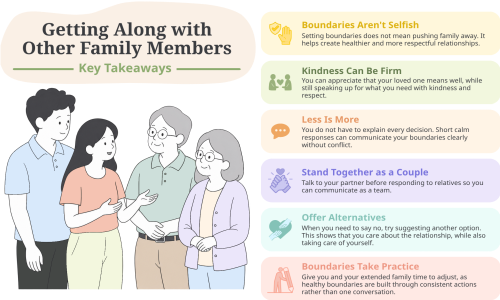
Boundaries can help people cope better, care for each other more thoughtfully and create healthier relationships. Without them, relationships can become draining or frustrating. Setting boundaries means taking responsibility for our own feelings and actions. It is not about controlling others but about being clear how their choices affect you.
Example: When a relative expects you to attend every family event despite your work schedule, saying, "I cannot attend this week, but I will join next time," is not selfish. It helps you manage your time while still showing you care.
Boundaries make relationships stronger by helping eveyrone understand each other better. While some distance may be necessary in cases of repeated emotional harm, most situations can be improved by making expectations clearer. Boundaries let you stay connected within limits that make everyone more comfortable.
Example: If an aunt gives unwanted advice about your parenting, you do not have to stop seeing her. You can say, "I appreciate that you care, but we have decided to do it this way." This helps to keep the relationship respectful while reducing possible tension.
Knowing why boundaries matter is just the start. Using them in daily family life is where the real change begins. Read on for practical ways to set boundaries with warmth and respect.

Tips for setting boundaries
Be understanding but firm
Share your feelings clearly and calmly. Start by recognising the other person's good intentions - for example, "I know you care about us" - before saying what you need, such as "but we would like to handle this in our own way." This helps keep things respectful while still standing up for what matters to you.
Redirect gently
When faced with personal questions or unwanted advice, respond in a light and friendly way. Try phrases like, "We are still figuring things out" or "It’s a work in progress”. Such responses stay warm without encouraging more questions.
Work together as a couple and limit what you share
Discuss expectations with your spouse beforehand so both of you can communicate consistently. Agree on what personal details to share and what to keep private. Being consistent helps avoid misunderstandings and mixed messages.
Offer other options
If you need to say no, suggest something else that keeps you connected. For example, "We cannot visit this weekend, but how about lunch next week?" This shows you care while still looking after your own needs.

Finding the balance between your personal life or marriage life and family involvement takes time, and change will not happen overnight. Give your extended family time to adjust. With patience and consistency, most families eventually find a new balance.
Setting boundaries with in-laws and relatives is not always easy, but it is possible. Talk openly with your spouse and support each other. Speak up of your needs with care, stick to your limits when it matters consistently, and be willing to give a little where it matters less. More importantly, be kind to yourself. It is normal to feel uncomfortable when learning new ways of relating to the people you love.
With time and effort, you can build a happier marriage while keeping your extended family as a loving and balanced part of your life.
If setting boundaries feels overwhelming or strains your relationships, consider seeking counselling support. A counsellor can work with you and your family and find ways communicating that feel respectful and caring for everyone involved.
Images in this article are created with AI.