A Singapore Government Agency Website

Getting Along with Your Parents as an Adult
Maintaining a positive relationship with your parents.

Getting Along with Your Parents as an Adult

By: Mr Daniel Chan, Head, Bachelor of Counselling Programme, Singapore University of Social Sciences (SUSS)
Recommended for: Anyone aged 21 and above who wants to build a healthier relationship with their parents
Topics: Family relationships, growing up, emotional independence, personal boundaries
30 Oct 2026 ⋅ 5-8 min read
Before You Read: A Quick Guide to This Article
Do you feel confident and independent everywhere in your life — except at home with your parents?
Many adult children fall back into old habits when they are around their parents, even after they have grown up.
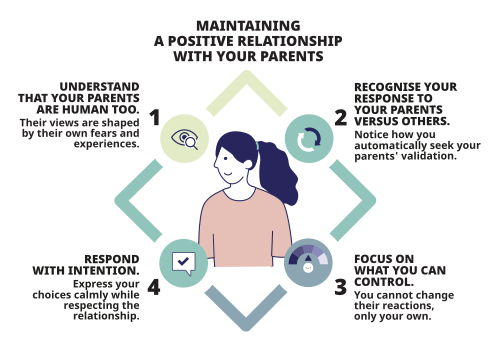
Mr Daniel Chan explains why this happens and gives four simple steps to help you grow beyond these habits:
- Seeing your parents as people who have their own fears and worries
- Noticing the automatic reactions you have around your parents that you do not have elsewhere
- Focusing only on what you can control, rather than trying to change your parents
- Learning to respond in a calm and thoughtful way that reflects who you are today.
As an adult, are you able to relate to this experience? At work, or in your studies, or with your peers, you find yourself fairly comfortable in expressing your views, preferences, and decisions aligned with your own rationale. However, the same you at home finds it somewhat challenging to respond in the same manner toward your parents. You observe that the patterns in how you relate to your parents have become established over time during your growing-up years. A sense of puzzlement, confusion, and helplessness strikes you as you look at your different responses across different contexts.
It is a profoundly jarring experience to realise that you are a relatively more independent adult outside of your family yet feel enslaved to the familiar and established family patterns at home. For example, this feeling might be triggered by an often-repeated piece of feedback from our parents, such as, 'This behaviour is so typical of you...' Immediately, we find ourselves falling into a reactive state. Our automatic responses take over, and the familiar interaction patterns lead to the same frustrating outcome, over and over again.
Does the above scenario sound familiar to you? Welcome to the world of adulting. Rest assured that you are not alone in this experience. The good news is that in the midst of experiencing this profound difference, we are presented with the opportunity to develop a new way of relating to our family as we shift the way we view our freedom and our responses.
1. Recognising that the parent is also a human
From a young age, we often regard our parents as all-powerful authority figures, consciously or unconsciously. The effect of this unconscious belief can be seen in our responses of disappointment, feeling misunderstood, or feeling helpless, even though we may outwardly express different opinions from our parents. One of the crucial steps in developing the needed independence as adults is adjusting this lens to see our parents as human beings who have their own unresolved issues, common fears, and lived experiences.

First, this reframed view helps to minimise disappointment. When we let go of the expectation that our parents are all-powerful, we are less triggered when their responses and behaviours simply reflect their human limitations. Second, recognising our parents’ humanity allows us the space to develop our own opinions, decision-making processes, and responses. This is necessary for our developmental milestones as individual adults as we move away from depending on our parents to validate our choices.
For example, when your parents question your job decision, observe the situation objectively. Their desire for you to have a specific, stable job might simply be their own unexamined anxiety about your job security, shaped by their past challenges. Recognising them as humans operating from their own fears helps depersonalise their comments, mitigating the influence of our own reactive emotions and responses.
 Try this
Ask yourself: "When I feel disappointed or defensive around my parents, am I reacting to the all-powerful authority figure from my childhood, or to the human being sitting in front of me today?"
2. Making conscious our automatic responses from the past
While recognising that parents are also human helps us gain insight into our parents’ responses, we also need to understand our internal automatic responses. In our process of growing up, we developed established and familiar ways of responding to our parents to feel secure or to seek their validation. These automatic responses become a script that we follow unconsciously without thinking that they feel so natural as a part of us.
Hence, when we experience the familiar effect of a parent’s disapproval or disagreement today, it can trigger our unconscious memories of needing to be compliant, “good,” or the fear of being rejected. This may explain why we over-explain our choices to our parents to seek their approval or perhaps shut down and distance ourselves from them. The act of shutting down and distancing ourselves incidentally reveals the effects of the unconscious influence. Developing a deeper awareness of these automatic responses, which no longer reflect our current abilities, is vital. It allows us to separate our former need for validation from our current reality as independent adults.
Try this
Ask yourself: “When I am with my parents, what automatic reactions do I notice that I do not have when I am with my peers, teachers, leaders, or supervisors? Am I following an 'old script' that has not been updated to take into consideration the adult that I have become?”
3. Achieving freedom by focusing on what is within your area of control
Reclaiming your freedom of agency requires a deeper understanding of what freedom looks like. Freedom does not mean having the financial freedom to spend on whatever you want or physical distance from people. Rather, it is the freedom to act in alignment with our values and intention, without being crippled by feelings such as guilt, helplessness and resentment.
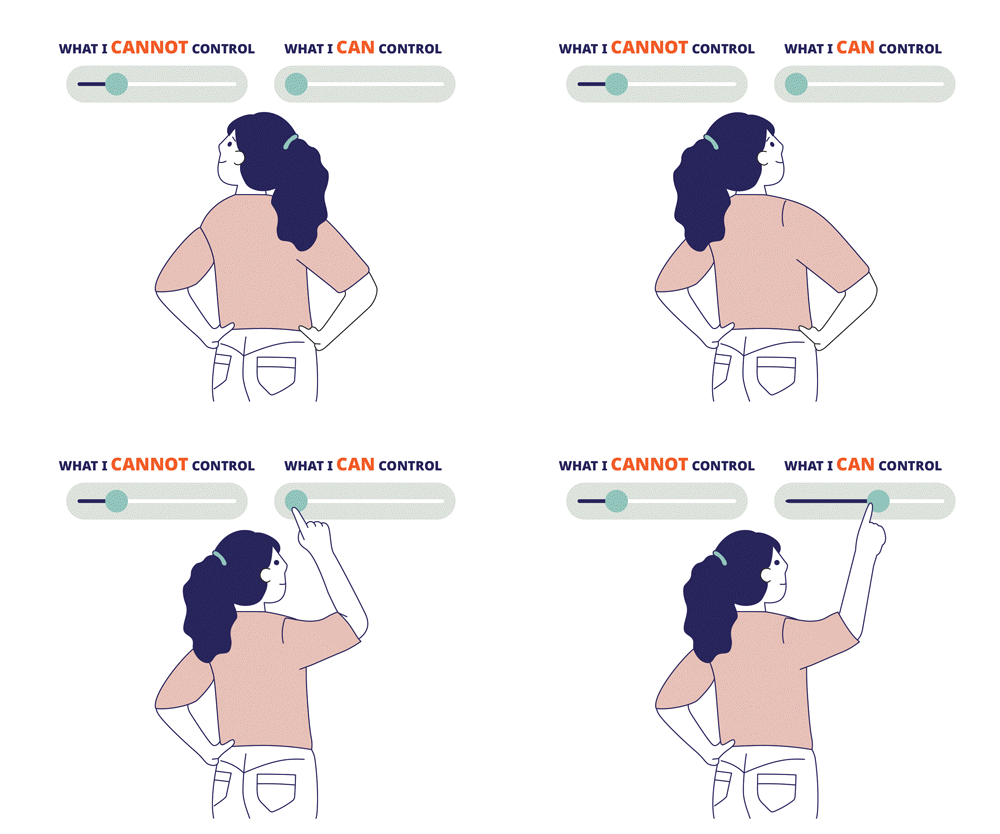
True independence is developed through an internal locus of control, whereby we focus on what is within our area of control. It is important to recognise that we cannot control our parents' demands, their differing perspectives, or whether they validate our choices. We can only control our own actions and responses. By letting go of the need to change their minds and focusing solely on what is within our control, we free ourselves from feeling helpless and being held captive by emotional reactivity. For example, we may purposely choose a job that is the opposite of what our parents want for us to assert to our parents that they no longer dictate our choices. Ironically, the intention of choosing the opposite of our parents’ choices shows that we are still held captive and not independent in making our own decisions.
4. Choosing our intentional and grounded response
Upon recognising our parents’ humanity, understanding our triggers that led to our automatic responses from the past, and being able to focus on what is within our area of control, these steps free us to choose our subsequent responses. In reclaiming our freedom of agency as independent adults, the goal is to remain engaged in our relationship with our parents but detached from the emotional chaos.
For example, when faced with a demand or criticism of our choice to explore a different job nature in our early twenties, we can choose to respond in an intentional and grounded manner. To do so requires us to be curious in understanding why our parents might be so insistent about job security and to find out more about their unresolved issues, common fears, and lived experiences which prompt them to prioritise job security over all other factors.
Try this
Ask yourself: “What is different about my current context and situation such that I may prioritise other factors such as job fit, alignment with my values and strengths and meaning over job security?”
This question can also be applied to other decision-making processes and other differences in opinions. In doing so, we are honouring the fact that as individuals, we are influenced by our unresolved issues, common fears, and lived experiences. With practice and over time, we can seek to choose our intentional and grounded response in communicating our thoughts and ideals. For example, explaining that we are seeking a good job fit that enables us to thrive and do well at work, while respectfully acknowledging their care. This allows us to affirm our choices as adults, establishing clear boundaries while maintaining the connection.
Incidentally, both parties may be concerned about the adult child doing well and being successful at work, although the approach to doing so may differ.
Give yourself time as you seek to gain greater insight into yourself and your parents through the four steps of recognising your parents’ humanity, gaining insight into your automatic responses from the past, focusing on what is within your area of control, and choosing your intentional and grounded response. Please recognise that understanding and practising these four steps requires time, effort, and repeated practice, which can be worked through with a counsellor.
We wish you a rich and fulfilling experience in breaking the cycle of learned helplessness and establishing a more satisfying and closer adult-to-adult relationship with your parents as you and your parents continue to grow.